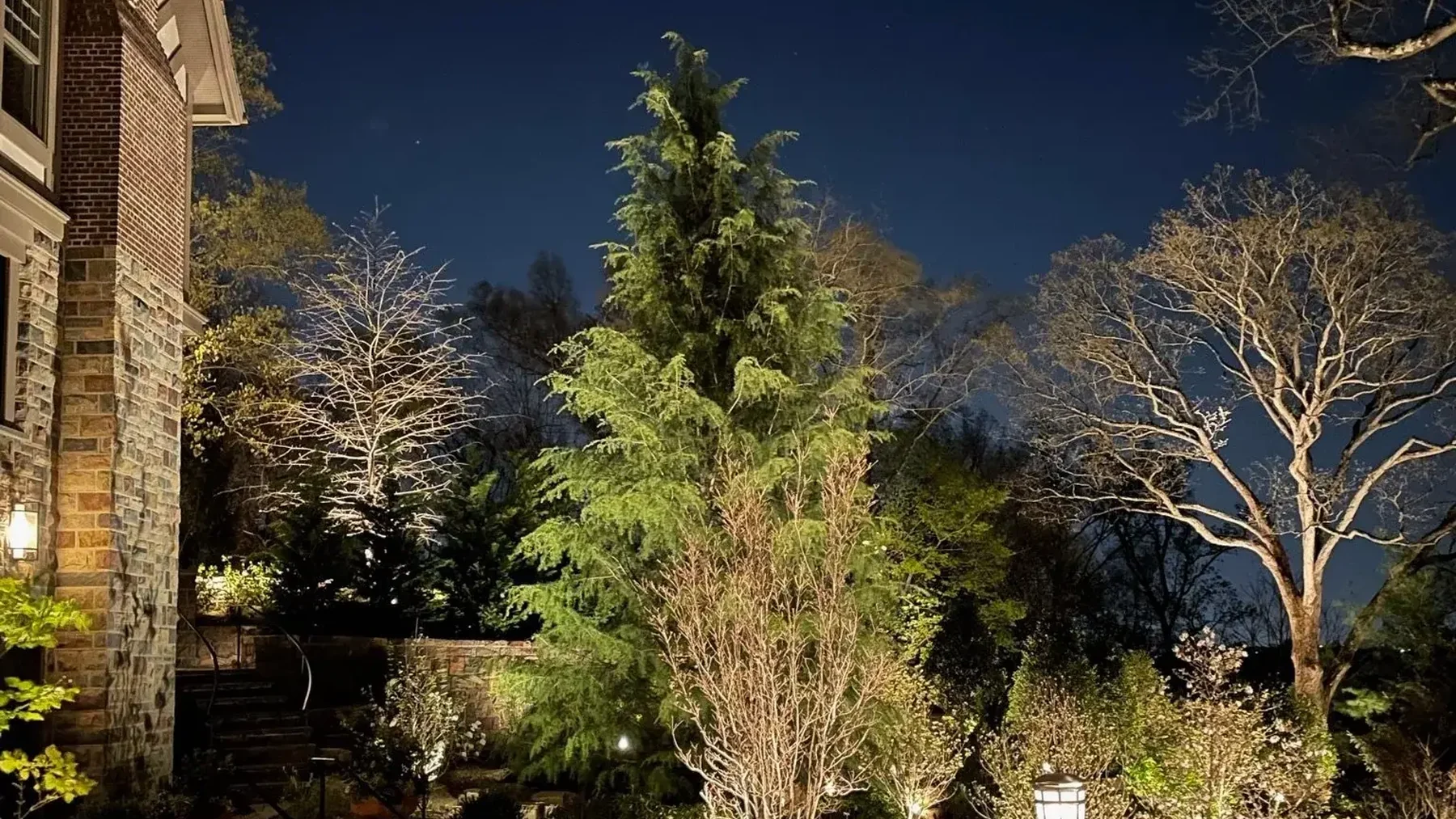
Most people think of landscape lighting as fixtures pointed up, washing a tree trunk or a stone facade with light. But some of the most beautiful effects in a Franklin yard come from doing the opposite: mounting soft lights high in the trees and aiming them down. Called moonlighting or downlighting, this technique mimics the dappled glow of a full moon filtering through the canopy, and it transforms a Williamson County property into something that feels natural and magical after dark. Here is how moonlighting works and why it fits the mature, tree-filled lots around Franklin so well.
Moonlighting means placing fixtures well up in a tree, often fifteen to thirty feet, and aiming them downward through the branches. As the light filters past leaves and limbs, it casts gentle, shifting shadow patterns on the lawn, patio, or driveway below, exactly the way real moonlight does. Instead of a single dramatic beam, you get soft, ambient illumination across a wide area with a natural quality that uplighting cannot replicate. It is subtle, elegant, and increasingly requested on the larger wooded properties of Williamson County.
Franklin and the surrounding areas like Leiper's Fork, Grassland, and the older neighborhoods near downtown are full of mature hardwoods, large oaks, maples, and poplars with the height and canopy spread that moonlighting needs. A technique that requires a tall, full tree is right at home here. On a sweeping Williamson County lot with established trees, moonlighting can light an entire backyard, patio, or garden path with a soft wash that feels like the landscape is glowing from within, which is a very different and more sophisticated effect than a yard dotted with bright spotlights.
The two techniques do different jobs and often work together. Uplighting dramatizes a specimen tree, highlights architecture, and creates bold focal points. Moonlighting provides soft, broad, ambient light that fills a space gently and feels natural. A well-designed Franklin property frequently uses uplighting to feature a few standout trees and the home's facade, while moonlighting bathes the gathering areas, the patio, the lawn, a seating nook, in that soft overhead glow. Combining them gives depth and realism rather than a one-note scene.
Certain spaces come alive under moonlighting. A backyard patio or outdoor living area feels intimate and inviting with dappled light from above rather than glare. A long driveway under a tree canopy, common on Williamson County estates, gets a gentle, safe wash of light. Garden paths and lawns take on texture from the moving shadows. Even a pool or water feature looks more natural lit softly from above. Anywhere you want ambiance without the harshness of bright fixtures is a candidate for this technique.
Moonlighting is technique-sensitive, and placement is everything. The fixtures must be mounted carefully in the tree, angled to rake light through the branches rather than blast straight down, and hidden so you see the effect, not the source. Shielded, glare-free fixtures are essential so the light reads as soft moonlight and not as a spotlight in a tree. Because the fixtures are high up, they need secure, tree-friendly mounting that will not harm the tree as it grows. This is skilled work, not a stake-in-the-ground job.
A common and fair concern is whether mounting lights hurts the tree. Done correctly, it does not. We use mounting methods and hardware designed to accommodate the tree's natural growth, avoiding tight straps or fasteners that would girdle a limb over time, and we run the low-voltage wire loosely so it does not constrict branches. Our Middle Tennessee hardwoods are robust, and professional moonlighting respects the tree so it stays healthy while carrying the fixtures for years. Protecting the tree is part of doing this right.
Like the rest of a quality system, moonlighting runs on low-voltage LED fixtures, which are safe, efficient, and long-lasting. The soft effect does not require bright, power-hungry lamps, so a moonlighting scheme adds very little to an energy bill while running on timers or smart controls that bring the yard to life at dusk. The International Dark-Sky Association also favors shielded, downward-directed lighting, which is exactly what moonlighting is, so it is a responsible choice for a Franklin neighborhood that values a dark, star-filled night sky.
Because moonlighting covers broad areas, it pairs naturally with smart control. We often put the moonlighting on its own zone so you can run that soft ambient layer on its own, perhaps left on later into the evening, while the accent uplighting on the home and feature trees runs on a different schedule. Astronomic timers adjust automatically as Middle Tennessee sunset shifts through the seasons, so the yard always comes on at the right moment without you touching anything. Layered zones are what make a lighting design feel designed rather than simply switched on.
One reality of moonlighting is that trees are living, growing things, and a fixture perfect this year may need adjusting in a few seasons as branches fill in and the canopy thickens. Part of a professional moonlighting relationship is revisiting the fixtures periodically to re-aim them, loosen mounting hardware so it never constricts a growing limb, and clear any leaves or debris from the lenses. In Middle Tennessee, where our hardwoods put on real growth each year, this gentle upkeep keeps the effect looking intentional and keeps the tree healthy, and it is far less involved than people expect.
Williamson County homeowners love to entertain outdoors, and moonlighting is tailor-made for it. A patio or lawn washed in soft overhead light lets guests move and mingle comfortably without the harsh pools and dark gaps that stake lights create, and it photographs beautifully for the gatherings people love to host in Franklin. Because the light feels natural rather than staged, it sets a relaxed, upscale mood that suits everything from a quiet family dinner to a large backyard party. It is lighting that works for people, not just for looks.
Moonlighting is one of the most elegant effects available in landscape lighting, and Franklin's mature, wooded lots are nearly ideal for it. The result is a yard that glows softly and naturally after dark, perfect for entertaining or simply enjoying a Williamson County evening. Because the technique depends on careful fixture placement, tree-safe mounting, and glare control, it is best designed and installed by professionals. We would be glad to walk your property, identify the trees that would carry the effect, and show you how moonlight would transform your yard.
Uplighting aims fixtures upward to dramatize a tree, wall, or architectural feature and create bold focal points. Moonlighting places shielded fixtures high in a tree and aims them down through the branches, casting soft, dappled light that mimics a full moon. Uplighting features specific elements; moonlighting fills a space with gentle ambient light. The best Franklin designs often use both together for depth.
Done correctly, no. We use tree-friendly mounting hardware and run the low-voltage wire loosely so nothing girdles or constricts a limb as the tree grows, and we revisit the hardware over time. Middle Tennessee hardwoods like oak, maple, and poplar are robust and carry professional moonlighting fixtures well for years when the installation respects the tree.
Soft, natural tree moonlighting designed and installed across Franklin and Williamson County.