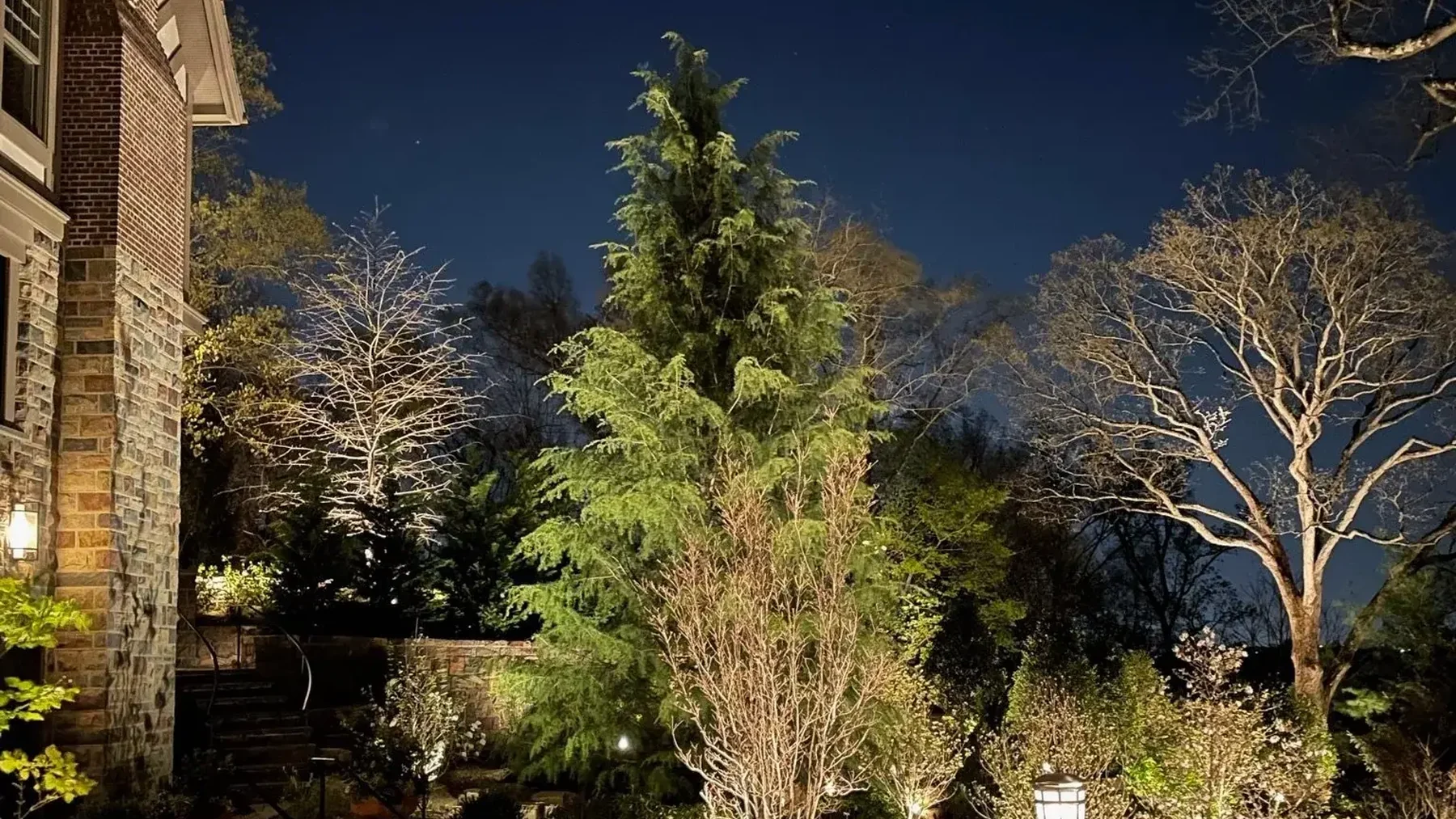
As Franklin and the surrounding Williamson County countryside continue to grow, more homeowners are thinking about how their outdoor lighting affects the night — the ability to see stars over Leiper’s Fork, the comfort of neighbors, and the wildlife in our green spaces. Dark-sky-friendly landscape lighting has become a meaningful movement, and the best news is that it is not a compromise. Lighting your home responsibly is simply lighting it well: warm, shielded, aimed, and sensible. This guide explains what dark-sky-friendly lighting actually means, why it produces a more elegant result, and how Franklin homeowners can have a beautifully lit property without contributing to light pollution.
Dark-sky lighting is often misunderstood as turning the lights down or off. In reality it is a set of common-sense principles: use light only where you need it, shield fixtures so light goes down and out toward the target rather than up into the sky, keep brightness at appropriate levels, and choose warm color temperatures. These are the same principles behind genuinely good landscape lighting design. The point is not darkness — it is precision. Light that is controlled and aimed looks intentional and refined, while light that sprays everywhere looks cheap and creates the glow that washes out the stars over Middle Tennessee.
Counterintuitively, respecting the night sky usually makes a property more beautiful, not less. Glare is the enemy of good lighting: a bright, unshielded bulb in your sightline makes your pupils contract, so you actually see the landscape less well even though there is more light. Shielded, well-aimed fixtures eliminate that glare and let the eye take in the softly lit home, trees, and gardens cleanly. The effect is calmer, richer, and more high-end. When Franklin homeowners see the difference between a glaring floodlit yard and a shielded, layered design, the dark-sky approach wins on looks alone.
The heart of dark-sky lighting is fixture selection and placement. We use shielded fixtures that direct light precisely — downlights that wash a path or patio without spilling upward, uplights carefully aimed and often shrouded so the beam hits the tree or wall and not the neighbor’s window or the sky. Full-cutoff and well-shielded designs keep light on target. Combined with thoughtful placement low in the beds, this precision means every watt does visible work on your property rather than escaping as wasted, sky-glowing light. It is a more disciplined way to light, and it shows in the result.
Two more dark-sky principles are warmth and restraint. Warm-white light scatters less and is gentler on the eye and on wildlife than harsh blue-white light, and it flatters the brick, stone, and greenery of Franklin homes. Appropriate brightness matters too — more light is not better past a certain point, and over-lighting creates glare and waste. We design to the right level for each area: enough to be safe and beautiful, never so much that it glares or bleeds into the sky. Getting color and brightness right is where many DIY and big-box lighting jobs go wrong.
Many homeowners assume security means bright, always-on floodlights, but that approach often backfires. Harsh glare creates deep shadows that give intruders places to hide and blinds the eye to movement. A smarter security strategy uses shielded, well-placed lighting and motion activation — light that comes on when something moves is both a stronger deterrent and far less wasteful than a floodlight burning all night. For Franklin homeowners, a dark-sky-minded security plan delivers genuinely better protection while sparing the neighborhood the glare and light pollution of old-fashioned floods.
In tight Williamson County neighborhoods and out in the more rural stretches alike, responsible lighting is part of being a good neighbor and steward of the area’s character. Keeping light on your own property, out of neighbors’ windows, and off the night sky reflects a growing awareness that outdoor lighting has consequences for people and wildlife. Organizations like DarkSky International have documented how much unnecessary light pollution we create and how easily good design reduces it. Choosing dark-sky-friendly lighting is a small way to help preserve the beauty of Middle Tennessee evenings.
The bottom line is that you do not have to choose between a beautifully lit home and a respect for the night — done right, they are the same thing. Shielded, warm, well-aimed, appropriately bright landscape lighting gives you an elegant, safe, comfortable property and keeps the stars in the sky. It is simply better lighting, and it is how we design for every Franklin home we light. If you want a landscape lighting plan that is as considerate as it is beautiful, we would be glad to show you what a dark-sky-friendly design can do for your yard.
Part of a responsible lighting plan is not just how light is aimed but when it is on. Timers, photocells, and smart controls let your landscape lighting run when it adds value — through the evening while you are enjoying the yard or entertaining — and dim or shut off in the small hours when no one benefits from it. Zoning the system so you can light only the areas you are using, rather than the whole property all night, cuts waste further. For Franklin homeowners these controls also add convenience and can lower energy use, so they pay off in comfort and cost as well as in reduced light pollution. Good controls are an easy, high-value part of a dark-sky-minded design.
If you already have landscape lighting that glares or spills, you do not have to start over. Many systems can be brought closer to dark-sky-friendly with targeted changes: swapping harsh cool bulbs for warm ones, adding shields or glare guards, re-aiming fixtures that throw light where it is not wanted, and adding controls to limit run time. We regularly assess existing installations around Franklin and Brentwood and recommend the handful of adjustments that make the biggest difference. Often a few smart tweaks transform a glaring, wasteful setup into something elegant and considerate without the cost of a full replacement — a practical path for homeowners who want to do better with what they already have.
Not at all. Dark-sky principles are really just good lighting design: aim light where you want it, shield it so it does not spill up or glare out, and use warm color and sensible brightness. The result is often more beautiful, because glare-free light reveals your home and landscape cleanly instead of blasting everything flat. You get an elegant, comfortable yard and keep the Middle Tennessee night sky — the two goals work together.
Yes, and it is usually more effective. Harsh, always-on floodlights create deep shadows and glare that actually help intruders hide. Shielded, well-aimed fixtures and motion-activated lighting provide better real security while cutting wasted light and glare. For Franklin homeowners, a thoughtful dark-sky approach delivers safety and beauty without the light-pollution downsides of old-fashioned floodlighting.
Why Fixture Quality Matters in Middle Tennessee's Climate — Custom landscape lighting designed, installed, and serviced across Franklin and Williamson County.